
Some mornings, your skin tells you what your mirror confirms. It looks flat, a little rough, and less even than usual. Foundation catches on dry patches. Sunscreen pills. The glow you had in mind is not the glow looking back at you.
In Australia, climate plays a large role in that feeling. Heat, wind, indoor cooling, salt, pollution, and relentless UV exposure all affect how the surface of the skin behaves. Dead cells do not always shed neatly. They linger, mix with oil, and leave the complexion looking dull or congested.
Exfoliation helps, but only when it is done with restraint. Good exfoliation does not mean scrubbing harder. It means removing what the skin no longer needs, without disturbing what it still relies on. That distinction matters even more if your skin is sensitive, mature, easily flushed, or already stressed by sun.
A sound routine should make the skin look clearer and feel smoother within a sensible rhythm. It should also leave the barrier calm enough to tolerate the rest of your skincare. That is the standard to aim for when learning how to exfoliate skin properly.
Your Path to Radiant Skin Starts Here
Dull skin is rarely a sign that you need more products. More often, you need better surface management.
When dead skin cells build up, they scatter light unevenly. The skin feels less smooth, active products sit on top instead of absorbing well, and texture becomes more obvious. In clinic practice, this is one of the most common reasons people think their skincare has stopped working.
Australian skin often needs a more careful approach than generic online advice suggests. Sun exposure is part of daily life, even when you are not at the beach. Air conditioning dries the surface. Coastal humidity increases oil and congestion for some people, while inland and southern conditions leave others tight and flaky. A routine that suits one person perfectly can irritate another within days.
The right form of exfoliation restores order to the skin’s surface. It can refine texture, reduce the look of congestion, and help the complexion appear fresher. The wrong form does the opposite. It leaves the skin shiny but not healthy, red but not renewed.
Key takeaway: exfoliation should leave skin clearer and calmer, not tight, hot, or stripped.
If you have ever wondered whether you should choose a scrub, an acid, an enzyme peel, or an oxygen-supported formula, the answer depends less on trends and more on your skin’s behaviour. Sensitive and UV-stressed skin usually benefits from a gentler hand. Oily or acne-prone skin often needs a more pore-focused approach. Mature skin needs renewal that respects a slower, more delicate barrier.
The Science of Renewal Physical vs Chemical Exfoliation
Exfoliation works in two main ways. You either lift away dead cells manually or loosen the bonds that keep them attached.
Neither method is automatically better. The question is whether the method matches your skin.
How physical exfoliation works
Physical exfoliation is the direct method. A scrub, cloth, brush, or polishing treatment removes surface buildup by friction.
Used well, it gives immediate smoothness. You can feel the difference straight away. This is why many people like it. The skin feels cleaner, makeup goes on more evenly, and roughness is reduced at once.
Used badly, it creates trouble quickly. Large particles, too much pressure, or overuse can scratch the surface and trigger irritation. That is especially relevant for skin that is already reactive from sun, heat, wind, or active ingredients.

How chemical exfoliation works
Chemical exfoliation is more precise. Instead of rubbing off dead cells, it uses ingredients such as AHAs, BHAs, or enzymes to dissolve the “glue” that keeps old cells clinging to the surface.
AHAs such as lactic acid and glycolic acid work mainly on the skin’s surface. They are useful when dullness, uneven texture, and early signs of ageing are the main concern. BHAs such as salicylic acid are oil-soluble, which makes them useful when pores, blackheads, and breakouts are the larger issue. Enzymes tend to be milder and are often a sensible option for very delicate skin.
In Australia, this choice matters because high UV exposure affects over 80% of the population, and Australasian College of Dermatologists guidance recommends exfoliating 1 to 3 times per week according to skin type (ACD guidance referenced here).
Which one is gentler
People often assume chemical exfoliation sounds harsher because “acid” sounds aggressive. In practice, a low-strength, well-formulated chemical exfoliant is often gentler than a rough scrub used with enthusiasm.
That is why the label matters less than the behaviour of the formula. A carefully made acid can be elegant. A badly made scrub can be brutal.
Consider these points:
- Choose physical exfoliation if you want immediate smoothness, your skin is not highly reactive, and you are disciplined with pressure.
- Choose chemical exfoliation if you want a more even, controlled renewal process and you are targeting dullness, congestion, or uneven texture.
- Choose enzyme-led exfoliation if your skin flares easily and you want the softest route.
For readers comparing acid types in more detail, this overview of alpha and beta peel differences gives a practical brand-level explanation of where each fits.
Tip: if your skin often stings after cleansing, start with the gentlest option available. Exfoliation should improve tolerance over time, not test it on day one.
How to Choose Your Perfect Exfoliant
The best exfoliant is not the strongest one. It is the one your skin will tolerate consistently.
When people choose poorly, they usually make one of two mistakes. They buy for the problem they want to solve, not the skin they have. Or they copy a routine built for someone living in a different climate, using different actives, with a completely different barrier.
Match the exfoliant to the behaviour of your skin
If your skin feels dry, tight, or easily flushed, start with a milder option. Lactic acid is often a sensible choice because it exfoliates with a softer touch and suits skin that needs comfort as much as brightness. Enzyme exfoliants can also work well when even mild acids feel too active.
If your skin blocks pores easily, salicylic acid deserves attention. For acne-prone skin, 2% salicylic acid peels can clear pores 50% faster than non-exfoliated routines, and acne-prone skin affects 23% of Australian teens and adults (Queensland University study reference).
If your skin is mature, sun-marked, and not very oily, a harsh pore-focused product usually misses the point. You need resurfacing that improves texture without pushing the skin into a reactive state.
When a scrub still makes sense
Physical exfoliants are not the villain. Poorly designed ones are.
A good facial scrub should have refined particles, glide well, and rinse cleanly. It should not feel like sandpaper. It should not leave the skin hot. If a scrub gives you that “squeaky” sensation, it has usually gone too far.
For people who enjoy a tactile step, a very fine scrub once or twice weekly can fit nicely into a routine, particularly for normal-to-oily skin that tolerates friction well.
Quick comparison guide
| Skin Type / Concern | Recommended Exfoliant Type | Key Ingredients to Look For | Karin Herzog Recommendation | Frequency |
|---|---|---|---|---|
| Sensitive or easily reactive skin | Gentle chemical or enzyme exfoliant | Lactic acid, mandelic acid, enzymes, PHAs | Mild, low-irritation exfoliating formats | Start low and adjust carefully |
| Dry or flaky skin | Hydrating chemical exfoliant | Lactic acid, gentle AHAs | Cream or mask textures that do not strip | Usually less often |
| Oily or acne-prone skin | BHA-led chemical exfoliant | Salicylic acid | Pore-focused exfoliation with barrier support | Build gradually |
| Normal or combination skin | Either gentle scrub or mild acid | Fine particles, lactic acid, mandelic acid | Alternate methods rather than layering all at once | Moderate rhythm |
| Mature, UV-stressed skin | Enzyme or gentle oxygen-supported exfoliation | Enzymes, soft AHAs | Low-abrasion resurfacing with recovery support | Conservative and consistent |
The trade-offs people overlook
Not every good ingredient is good for every week of your skin’s life.
- After beach exposure: skin may look dull, but it may also be more vulnerable. Delay anything aggressive.
- During breakouts: do not assume more exfoliation will fix irritation-driven acne.
- During winter wind or indoor heating: reduce frequency before your skin asks for mercy.
- When using retinoids: keep your exfoliation plan simpler, not more ambitious.
If you are deciding between acid families, this comparison of salicylic acid or glycolic acid is a useful companion read because it reflects the practical difference between congestion-focused and surface-renewing exfoliation.
Practical rule: choose for tolerance first, results second. Well-tolerated exfoliation produces better skin than an aggressive product you can only use once before reacting.
Your Step-by-Step Exfoliation Ritual
Technique changes outcomes. The same product can behave beautifully in one routine and badly in another.
A careful ritual keeps exfoliation effective without turning it into damage.

Before you begin
Start with clean skin. Remove sunscreen, makeup, sweat, and surface grime first so the exfoliant reaches the skin evenly.
Pat the skin so it is either dry or very slightly damp, depending on the product format. Scrubs usually behave better on damp skin. Many acid products are best applied exactly as directed, often to dry skin for more controlled contact.
Do not exfoliate over freshly shaved, sunburnt, peeling, or visibly inflamed skin.
If you are using a physical exfoliant
Use very little. For physical exfoliation, a pea-sized amount of a fine-granule scrub used in light circular motions for no more than 30 seconds, 2 to 3 times per week, can improve glow by 80% and clear pores by 50% within 28 days, while harsh pressure can cause micro-tears in 35% of cases (protocol reference here).
That figure supports what clinicians see often. Pressure is the mistake, not the concept of scrubbing itself.
Use this order:
- Dampen the skin lightly
- Massage with fingertips only
- Keep the movement soft and brief
- Rinse with lukewarm water
- Stop if the skin feels hot, raw, or over-polished
If you are using a chemical exfoliant
Apply in a thin, even layer. Do not rub it in as if force will improve performance.
A simple order works well:
- Cleanse first
- Apply the exfoliant sparingly
- Allow the directed contact time
- Neutralise or rinse if the format requires it
- Follow with hydration
- Finish with sun protection the next morning
The biggest error with acids is stacking too much at once. A toner, peel pad, resurfacing serum, and active mask in one evening is not discipline. It is confusion.
A brief visual guide can help if you prefer seeing technique in action.
What to apply afterwards
After exfoliation, the skin needs recovery ingredients more than drama.
Choose a hydrating serum, a simple moisturiser, or both. If your barrier is already fragile, avoid fragranced products and strong actives immediately after exfoliation. The goal is to support the skin while it resets.
This is also the moment to be strict about daily sunscreen. In the Australian climate, post-exfoliation UV exposure is one of the fastest ways to turn a good habit into irritation and pigmentation trouble.
If your skin barrier already feels unsettled, this guide on how to repair a damaged skin barrier is worth reading before you increase exfoliation frequency.
Tip: the morning after exfoliation, your skin should feel smoother and look fresher. If it feels tight, shiny, and oddly sore, reduce frequency or switch method.
Advanced Exfoliation Navigating Actives and Safety
The most common skincare mistake is not under-exfoliating. It is assuming that more activity always means better skin.
That idea collapses quickly in Australian conditions, especially for fair, sun-damaged, or easily reactive skin. For Australians with sensitive skin exposed to high UV conditions, 62% of fair-skinned respondents in a 2024 dermatology survey reported post-exfoliation flare-ups, and oxygen-infused gentle AHAs may reduce irritation by 30% via enhanced cell renewal without barrier disruption (survey reference).

How to combine exfoliation with retinoids and vitamin C
Retinoids and exfoliants can both be valuable. They just should not compete for the same evening when your skin is not ready.
A safer approach is to alternate. Exfoliation one night, retinoid another. If your skin is new to both, introduce one first and stabilise before adding the next.
Vitamin C is often easier in the morning, with exfoliation in the evening. That spacing reduces the chance of unnecessary irritation and makes routines easier to follow.
Signs you are doing too much
Over-exfoliation rarely begins dramatically. It starts subtly.
Watch for:
- Unusual shine that looks taut rather than healthy
- Persistent stinging when applying basic products
- Patchy redness that lingers
- Flaking with soreness, not simple dryness
- A breakout pattern that feels inflamed rather than congested
Many people misread these signs and exfoliate more because the skin feels rough. That roughness is often barrier damage, not leftover dead cells.
A simple recovery plan
If your skin is overworked, pause active exfoliation and simplify.
Use:
- A bland cleanser
- A moisturiser focused on barrier support
- Daily broad-spectrum SPF
- Patience
Once the skin feels settled again, reintroduce exfoliation slowly. Choose a lower-intensity format and spread applications further apart than you think you need.
For those exploring stronger resurfacing options, this guide to a glycolic acid peel is useful reading before you move upward in strength.
Clinical rule: if a routine gives fast brightness but poor comfort, it is not advanced skincare. It is a short-lived result with a repair bill attached.
Curated Exfoliation Routines for Your Skin Goals
A useful routine should suit a real life, not an ideal one. Few individuals have time for ten steps, and Australian skin often responds better to consistency than intensity.
The routines below are frameworks. Adjust the frequency to your tolerance, season, and sun exposure.

The calm routine for sensitive and easily flushed skin
This is the routine for skin that reacts before it rewards.
Morning
- Gentle cleanse
- Hydrating serum or light moisturiser
- Broad-spectrum SPF
Evening
- Cleanse carefully
- Use a mild enzyme or very gentle acid exfoliant on selected nights only
- Follow with a barrier-supportive cream
If your skin is rosacea-prone or often red after heat and sun, avoid rough scrubs. For mature Australian skin, particularly where rosacea is becoming more common, enzyme or oxygen-boosted peels outperformed standard AHAs in a Q1 2026 Perth Dermatology Association study, boosting collagen by 22% with 40% less downtime (study reference).
That result fits what many sensitive-skinned patients need. They want renewal, but they cannot afford the inflammation tax.
The anti-ageing routine for time-poor professionals
This routine suits skin that looks tired, uneven, and a little weathered by travel, office air, and daily UV.
Morning Cleanse lightly, then use hydration and sunscreen. Keep mornings steady and protective.
Evening Use a gentle exfoliant on planned nights, not impulsively. On non-exfoliation nights, focus on nourishment and reparative care. If you are using a vitamin A cream, alternate it with exfoliation rather than layering both.
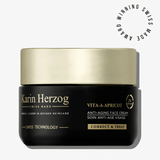
One sensible product option in this category is Karin Herzog Vita-A-Kombi, used as part of a broader evening routine that prioritises barrier comfort after exfoliation. It fits best on non-acid nights or after a very mild exfoliation schedule, depending on tolerance.
The clarifying routine for acne-prone skin
This is for skin that clogs easily, especially across the nose, chin, jawline, or back.
Morning
- Cleanser suited to oily or blemish-prone skin
- Light hydration if needed
- SPF without fail
Evening
- Cleanse thoroughly
- Use a salicylic-acid exfoliant on your scheduled nights
- Follow with a non-heavy moisturiser
The key here is restraint. Acne-prone skin often tempts people into stripping cleansers, abrasive scrubs, and too many spot treatments. That approach usually worsens inflammation. Pore clarity improves more reliably when exfoliation is regular, targeted, and balanced by hydration.
The maintenance routine for normal or combination skin
This person often says, “My skin is mostly fine, but it looks dull.”
A maintenance rhythm works well:
- One or two exfoliation nights weekly
- One method at a time
- Extra caution after long outdoor days
You might choose a fine scrub when the skin feels textured and a gentle acid when it looks dull. There is no rule that says you must be loyal to one texture forever. The key is not to use both aggressively in the same sitting.
A simple way to decide each week
Ask four questions:
- Does my skin feel calm or sensitised?
- Have I had heavy sun exposure recently?
- Am I already using strong actives this week?
- Do I need pore clearing, surface smoothing, or just maintenance?
Your answer tells you whether to exfoliate, what kind to use, and whether to wait.
Practical takeaway: a good exfoliation routine is not fixed. It adapts to weather, UV load, travel, hormones, and barrier condition.
Common Exfoliation Questions Answered
Can I exfoliate if I have rosacea
Sometimes, yes, but the margin for error is smaller. Avoid harsh scrubs and strong home peeling routines. Enzyme-based or very gentle resurfacing options are usually the more cautious path. If your rosacea is active, focus on calming the skin first.
Should I exfoliate at night or in the morning
Night is usually easier. The skin can recover undisturbed, and you are less likely to rush. Morning exfoliation is not forbidden, but it leaves less room for observing how your skin responds before daylight exposure.
Can I exfoliate if I have active breakouts
Yes, but choose the right type. Inflamed breakouts usually respond better to gentle chemical exfoliation than to mechanical scrubbing. Avoid rubbing over sore lesions.
How long does it take to see results
Some effects are immediate. Skin often feels smoother after the first properly done exfoliation. Clarity, tone, and a more refined texture generally require steady use rather than one dramatic session.
Is it normal to tingle
A mild tingle can happen with acids. Burning, prolonged stinging, or heat is not the goal. If discomfort continues after application, the product may be too strong, too frequent, or poorly matched to your skin.
Can I exfoliate my body too
Yes, and many people should, especially on rough areas such as arms, legs, and backs of thighs. Body skin is thicker than facial skin, so it often tolerates different textures. Use separate products for face and body where possible.
Do I need both a scrub and an acid
Not always. Many people get better results from one well-chosen method than from trying to combine everything. If you use both, alternate rather than stack until you know your skin tolerates the combination.
What should I never do after exfoliating
Do not chase the result with more actives because your skin looks bright. Avoid strong retinoids, rough cleansing tools, and unprotected sun exposure immediately afterwards.
Is exfoliation safe during pregnancy
It depends on the ingredient and your medical context. Some exfoliating options may still be suitable, but pregnancy is a time to check product ingredients with your treating doctor or dermatologist rather than guessing.
What is the biggest mistake people make
They confuse intensity with quality. Good exfoliation is measured by smoother texture, better clarity, and comfortable skin the next day. If your skin is angry, the routine is wrong, even if it looked polished for an hour.
If you want an exfoliation routine better suited to Australian skin conditions, explore the Swiss oxygen skincare range at Karin Herzog. Focus on products and routines that support renewal without overwhelming the skin, especially if you are managing sensitivity, dullness, congestion, or visible signs of sun stress.