
You catch it in ordinary moments. The bathroom light looks a little less forgiving. Concealer settles where it used to glide. By mid-afternoon, the skin under your eyes seems thinner, drier, and slightly creased, even when the rest of your face looks fine.
That is often when people start asking whether a firming eye cream is useful, or just another small jar making big promises. The honest answer is that some formulas are cosmetic quick-fixes, while others are designed to support real structural change over time. Knowing the difference matters.
The eye area ages differently from the cheeks or forehead. It moves continuously, it is easily dehydrated, and it tends to show fatigue, sun exposure, and collagen loss early. A good firming eye cream is not just a smaller face cream. It is a targeted formula built for skin that needs both precision and restraint.
Why Firming Eye Creams Are a Skincare Staple
The eye area often asks for help before the rest of the face does. You may notice a slight softness at the outer corners, a crepey texture under makeup, or a loss of bounce that makes the whole face look more tired.

Why the eye area needs special treatment
This skin has a difficult job. It stretches and folds every time you smile, squint, blink, or rub your eyes. It has less room for error. A formula that feels comfortable on the jawline can feel too heavy, too irritating, or ineffective around the eyes.
That is why a firming eye cream exists as its own category. It is meant to do three things at once:
- Support structure: Help skin look tighter and more resilient.
- Manage dehydration: Reduce the dry, papery look that exaggerates lines.
- Respect fragility: Deliver actives without overwhelming a delicate area.
For many Australians, the issue is even more obvious because sun exposure is part of daily life. Skin around the eyes frequently carries the visual effects of UV stress, even in people who otherwise take good care of their complexion.
Why this category keeps growing
Consumers are not treating eye care as an afterthought. The category has become more established because people want targeted solutions, not vague promises. The global anti-wrinkle eye cream market was valued at USD 3.52 billion in 2024 and is projected to reach USD 4.54 billion by 2032, while Asia-Pacific, including Australia, is projected to be the fastest-growing region according to 24 Market Reports.
That growth reflects something practical. People have learned that the eye area often needs its own strategy.
If your skin is easily reactive, this becomes even more important. A targeted formula can help you avoid the common mistake of using a strong anti-ageing face treatment too close to the eyes. If that sounds familiar, this guide on why a gentle eye cream for sensitive skin is a skincare must-have is a useful next read.
Key takeaway: A firming eye cream is not about adding an extra step for the sake of it. It is about matching the formula to the most vulnerable part of the face.
How Your Skin Loses Firmness and Elasticity
Firmness sounds abstract until you picture what gives skin its shape. I like to compare it to a mattress.
Collagen acts like the internal framework that keeps the mattress supported. Elastin behaves more like the spring system that helps it bounce back after pressure. When both are strong, the surface looks smooth and resilient. When they weaken, the surface starts to crease, dip, and stay marked.
The support system under the surface
Your eye contour depends on that same basic architecture. When collagen is plentiful, the skin looks denser and better supported. When elastin is functioning well, the skin snaps back instead of folding and lingering.
As time passes, that support network becomes less efficient. The result is familiar:
- Fine lines stay visible longer
- The outer eye area looks less lifted
- Under-eye skin appears thinner
- Texture becomes crepey instead of smooth
This is not just about age in years. It is also about wear.
What speeds up that loss
The first factor is simple chronology. Skin does not repair itself with the same ease forever. The second factor is movement. The eye area is in motion all day, so repeated folding gradually shows up on the surface.
Then there is the Australian reality of sunlight. UV exposure places extra stress on skin proteins. Over time, that stress contributes to the slackened, less springy look people describe as sagging or tiredness.
Lifestyle habits matter too. Inconsistent sleep, dehydration, friction from rubbing, and harsh products can all make the eye area look older than it is. They may not create every line, but they can make existing weakness far more visible.
Why firmness and dryness get confused
Many people assume every line means collagen loss. Not quite. Some lines are structural. Others are dehydration lines that appear when the surface lacks water and the barrier is under strain.
That is why one cream can make skin look better in a day, while another takes weeks. Hydration changes the surface quickly. Structural improvement takes longer because the skin needs time to rebuild and organise itself.
If you want the broader collagen picture, this article on how to increase collagen naturally gives a helpful overview of the habits and ingredients that support the skin’s framework.
Think of under-eye ageing as a combination of a weakening frame, tired springs, and a drier surface fabric. A useful firming eye cream should address more than one layer of that problem.
The Mechanisms Behind a Firmer Eye Contour
Consumers frequently shop for eye creams by ingredient name alone. That is understandable, but it leads to confusion. Two products can both contain “anti-ageing” ingredients and still behave very differently on skin.
What matters is the mechanism. In other words, what the formula is asking the skin to do.

Pathway one signals the skin to build
Some ingredients work like instructions. Peptides are the classic example. They do not function as instant fillers. They act more like messengers that encourage skin to support its own repair processes.
When a peptide formula works well, the effect is gradual. Skin may look a little smoother first, then a little firmer, then more resilient after continued use. This is subtle biology, not a dramatic overnight tightening.
Pathway two protects what you still have
The second pathway is protection. Antioxidants help defend the skin from the chain reactions triggered by environmental stress. Around the eyes, this matters because the area has little margin for cumulative damage.
You can think of antioxidants as maintenance staff. They do not rebuild the whole structure by themselves, but they help stop extra wear from accelerating the decline.
Pathway three changes the skin’s operating conditions
This approach interests many readers, because it is less talked about. Some formulas do not just signal collagen production or defend existing tissue. They try to improve the environment in which repair happens.
That is the logic behind stabilised oxygen technology. Instead of treating oxygen as a vague “radiance” concept, this approach focuses on cell energy and repair activity.
Here is the simplest analogy. Picture a factory with worn-out workers, dim lighting, and low power. You can deliver better instructions, but output still stays limited because the whole system is underpowered. Increase the available energy, and the factory can perform its normal tasks more efficiently.
In vitro studies on patented stabilised oxygen technology associated with Karin Herzog show it can increase ATP production in fibroblasts by up to 230% according to INCIDecoder’s referenced product research. Fibroblasts are the cells involved in creating collagen, so ATP matters because it is the cell’s usable energy currency.
That same source describes a 12-week clinical trial with a 28% improvement in eye contour firmness and a 35% reduction in crow’s feet, with 15% better hydration retention than standard peptide creams. Those findings are especially relevant for Australian skin dealing with photoageing stress.
Why oxygen is different from a temporary tightening film
A temporary tightening product works at the surface. It creates a quick-dry film or relies on rapid water shifts that make skin look smoother for a short window. Useful for an event, yes. Structural, no.
Stabilised oxygen aims at another level. The idea is not to pull the skin taut for a few hours. It is to support a healthier repair environment so the skin can function more effectively over time.
That distinction becomes important when people compare “instant firming” with genuine improvement. If you are also interested in the broader topic of body and facial firmness, this guide on how to tighten loose skin explains the same principle in a wider skin context.
What to look for in a serious firming approach
A strong formula often works through more than one route. Look for a combination of these goals:
- Cell support: Ingredients or technologies that help energise repair.
- Structural signalling: Compounds that encourage collagen-related activity.
- Barrier comfort: Enough hydration and lipid support to reduce crepiness.
- Protection: Defence against daily environmental stress.
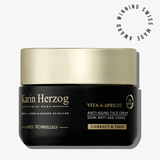
Some products focus on one route only. Others combine several. One example is Karin Herzog eye care, which uses stabilised oxygen as part of a firming strategy for the eye contour. If you want a broader explanation of skin-tightening approaches for the face, how to tighten skin on face is a helpful reference.
A practical rule: If a formula only promises “instant lift”, expect a cosmetic effect. If it is built around repair, protection, and energy support, expect a slower but more meaningful change.
Decoding the Ingredient List on Your Eye Cream
Ingredient lists frequently look more intimidating than they are. The useful way to read them is by job description, not chemistry exam.
I group firming eye cream ingredients into three families: the architects, the bodyguards, and the plumpers.
The architects
These are the ingredients that support the skin’s structure.
Peptides sit in this group because they help send repair-related signals. They are a sensible choice for people who want a steady anti-ageing ingredient without the volatility of stronger actives.
Retinoids also belong here. They are well known for texture and wrinkle support, but the eye area can be less forgiving.
That is why bakuchiol has become so interesting. For the Australian climate, bakuchiol at 0.5% concentration is described as an ideal retinol alternative. A 12-week double-blind study on 17 photoaged subjects showed 22% wrinkle reduction and 19% elasticity gain, while also being relevant to the 40% of Australian adults reporting skin sensitivity, according to Living Nature’s ingredient overview.
The bodyguards
These ingredients help skin hold up better under daily stress.
Vitamin C and vitamin E are common examples. Their role is not to act like instant wrinkle erasers. Their value is in helping reduce the burden of oxidative stress that contributes to an older-looking eye contour.
Niacinamide appears in this category too. It is appreciated because it can support the barrier while improving the look of uneven tone. Around the eyes, that can be useful when firmness concerns overlap with dullness or fatigue.
The plumpers
These are the ingredients people frequently notice first because the effect can be fast.
Hyaluronic acid draws in water and helps fine dehydration lines look softer. Ceramides help reinforce the barrier so that hydration is not lost as quickly. If the eye area feels tight, papery, or rough, this category matters.
For readers interested in plant oils as part of barrier support, this explainer on organic argan oil is a good companion read. Oils do not replace structural actives, but they can improve comfort and reduce surface dryness.
Key Firming Ingredients and Their Functions
| Ingredient | Primary Function | Best For |
|---|---|---|
| Peptides | Supports collagen-signalling pathways | Early firmness loss, fine lines |
| Bakuchiol | Retinol alternative for wrinkle and elasticity support | Sensitive skin, photoaged skin |
| Retinoids | Encourage skin renewal and structural improvement | Experienced users who tolerate stronger actives |
| Hyaluronic acid | Hydrates and plumps the surface | Dehydration lines, makeup creasing |
| Ceramides | Strengthens the barrier and reduces water loss | Dry, reactive, crepey under-eyes |
| Vitamin C | Antioxidant support | Dull-looking eye area, environmental stress |
| Vitamin E | Helps protect and condition skin | Dryness and daily exposure stress |
| Niacinamide | Supports barrier function and improves overall appearance | Uneven tone, mild sensitivity |
How to read a label without overthinking it
Ask three questions:
- Does it build? Look for peptides, bakuchiol, or another structural active.
- Does it cushion? Look for hydrators and barrier-support ingredients.
- Does it suit your tolerance? The most powerful ingredient is not helpful if your eye area cannot comfortably use it.
For a fuller rundown of actives worth knowing, best anti-aging ingredients is a useful ingredient guide.
How to Select Your Perfect Firming Formula
Choosing a firming eye cream gets easier when you stop asking, “Which one is best?” and start asking, “What is my main problem?”
The right formula for crepey dryness is not always the right one for crow’s feet. The right one for a resilient skin type may be wrong for someone who reacts to almost everything.
If crow’s feet are your main concern
Look for a formula that combines a structural active with good hydration. This is the group where peptides, bakuchiol, and well-designed oxygen-based systems make the most sense.
You want support that goes deeper than surface smoothing. If a product only creates a tight film, lines may look better briefly but return as soon as the effect wears off.
If the area looks soft or less lifted
This usually points to elasticity loss rather than simple dryness. You are looking for ingredients or technologies that support the skin’s own repair work and improve resilience over time.
That is also why consistency matters so much. A firming eye cream works more like exercise than makeup. Missing a day is not a disaster, but results come from repetition.
If your under-eyes are dry and crepey
Prioritise comfort first. A dehydrated eye area can make every line look worse. In this case, hyaluronic acid, ceramides, and nourishing emollients can make the skin look smoother and more settled.
After that, add a structural active if your skin tolerates it. This layered logic prevents the common mistake of throwing powerful ingredients at a barrier that is already struggling.
If your skin is sensitive or reactive
If your skin is sensitive or reactive, formulation quality matters more than ingredient buzzwords. Dr. Annie Chiu warns that many active ingredients can cause irritation around the delicate eye area and must be “specially stabilized or formulated”, as noted by Dermstore.
That advice is especially relevant if your eye area stings easily, becomes flaky, or reacts to retinoids. You are not just choosing an active. You are choosing the delivery system.
A good sensitive-skin formula should aim for:
- Controlled delivery: The active reaches skin without overwhelming it.
- Barrier respect: The formula reduces the chance of dryness and irritation.
- Daily usability: You can stick with it long enough to see change.
Decision shortcut: If your skin is reactive, choose the formula you can use consistently, not the strongest one on paper.
If you want one product to do more than one job
Multi-tasking can be sensible if the product is well built. A formula that supports firmness while also hydrating and protecting the barrier often suits busy routines best.
What matters is that the product has a clear mechanism, not just a long ingredient list. Long lists can look impressive while doing very little if the formula is unstable, irritating, or poorly balanced.
Maximising Results With Proper Application
A well-made eye cream can still disappoint if you apply too much, apply it too close to the lash line, or rub it in like face moisturiser.
Technique matters because the eye area is easy to irritate and easy to overload.
The simplest application method
Follow this order:
- Cleanse first: Apply to clean skin so the formula sits directly on the eye area.
- Use a small amount: A pea-sized amount is enough for both eyes.
- Choose your ring finger: It naturally applies less pressure.
- Place, then tap: Dot along the orbital bone and tap gently.
- Keep some distance: Do not push the product too close to the eye itself.
That “orbital bone” rule confuses people, but it is simple. Feel the bone around the eye socket. That is generally where most eye creams belong unless the product instructions specifically say it is suitable for a broader area.
Here is a demonstration of gentle eye-area application technique:
Where it fits in your routine
Apply your firming eye cream after cleansing and lighter treatment steps, then follow with your moisturiser if needed. In the daytime, finish with broad-spectrum sun protection.
For Australian conditions, that last step is essential. You cannot work on firmness at night and leave the eye area exposed by day.
Small habits that make a difference
- Be consistent: Daily use matters more than occasional heavy application.
- Do not rub: Friction can work against the very firmness you want to preserve.
- Do not overapply: More product does not mean better performance.
- Watch your response: If the area becomes persistently dry or stingy, reassess the formula and frequency.
Gentle, repeated application beats aggressive treatment. The eye area responds best to precision.
Setting Realistic Expectations for Your Eye Cream
The skincare industry often blurs two different outcomes. One is an immediate plumping effect. The other is a longer-term firming effect.
They are not the same thing.
Hydrators such as hyaluronic acid can make the under-eye look smoother quickly by increasing surface water content. That can be useful. It helps makeup sit better and softens the look of fine lines. But it is mostly a surface change.
Structural improvement takes longer. Experts discussing this gap in consumer understanding note that true firmness improvements typically require 4 to 8 weeks of consistent use, according to Healthline’s review of eye cream efficacy.
What to expect instead of a miracle
In the first stretch of use, you may notice:
- Better hydration
- A smoother makeup finish
- Less tightness or crepiness
Later, with consistent use, you may begin to see:
- A more resilient look at the outer corners
- A less softened eye contour
- Finer lines appearing less etched
The biggest mistake is expecting a jar to behave like an in-clinic procedure. A firming eye cream can support visible improvement, but it works through cumulative daily change.
The second mistake is quitting too early. If the formula is right for your skin, patience is part of the treatment plan.
Your Firming Eye Cream Questions Answered
Can I just use my face moisturiser around my eyes
Sometimes, but it depends on the formula. Many face creams are not built for the eye area’s sensitivity or for concerns like crepiness, crow’s feet, and loss of elasticity. A dedicated firming eye cream is more targeted and easier to tolerate.
When should I start using a firming eye cream
Start when you notice the first meaningful changes, or when you want to take a preventive approach. That might be early dehydration lines, a less springy texture, or makeup settling more than it used to.
Are premium eye creams worth it
They can be, if the price reflects real formulation work. Patented technologies, ingredient stabilisation, and clinical testing can all matter. The question is not whether the jar is luxurious. It is whether the formula has a clear mechanism and is comfortable enough for consistent use.
If you want a science-led approach to eye care, Karin Herzog offers Swiss-made oxygen skincare built around stabilised oxygen technology, with routines designed for concerns such as fine lines, firmness, hydration, and sensitivity.